Why Choose Precision Mold Components for Your Project?
Why Choose Precision Mold Components for Your Project?
Precision Mold Components can shape the consistency, efficiency, and service life of a molded product. Their value becomes clear in small details: a cavity insert that seats evenly, a guide pin that moves without binding, or a polished surface that releases parts cleanly. These details can reduce defects and help keep production stable. But precision alone is not a guarantee. The component must suit the material, mold design, operating conditions, and maintenance plan.
Quality expert Dr. Joseph M. Juran wrote, “Quality means fitness for use.” That principle applies here. A tight tolerance matters only when it supports the finished part and the production process. Buyers should review drawings, material specifications, surface-finish requirements, and inspection records with their supplier. Ask how critical dimensions are measured. Ask how wear-prone areas are handled. Small questions matter.
There is a trade-off. Higher-grade components may cost more upfront, while poorly matched parts can bring rework, downtime, or uneven output. A careful comparison should include expected service life, replacement access, and the cost of production interruptions. Real operating data is useful; assumptions are less so. Even a well-designed component can disappoint if installation or maintenance is neglected. That deserves a second look. The sections ahead explain where precision components make a measurable difference, what to check before ordering, and how to judge whether the added investment fits your project.
What Are Precision Mold Components?
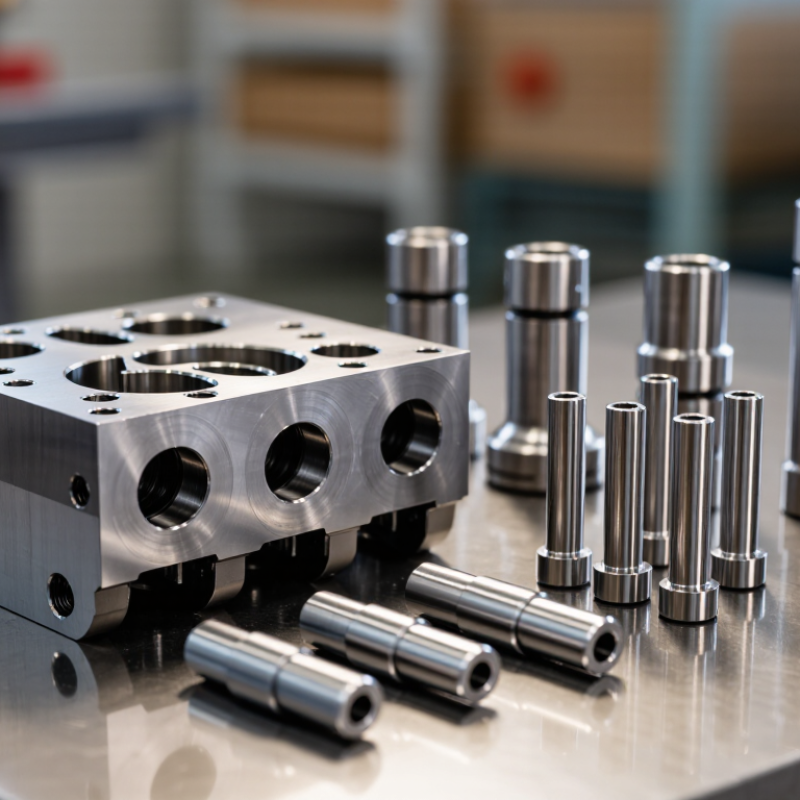
Precision mold components are the carefully made parts that guide, shape, and support a mold during production. They include cores, cavities, ejector pins, guide pillars, bushings, and inserts. Each part has a defined job. A cavity forms the product’s outer surface, while a core creates internal features such as holes or channels. Ejector pins help release the finished piece without damaging it.
Their dimensions and surface finishes affect how consistently a mold operates. For example, a poorly fitted guide pillar can cause uneven wear or misalignment over repeated cycles. Precision components are commonly produced from selected tool steels or other suitable materials, then machined, ground, and inspected against specified measurements. Small details matter. A tiny burr around an insert can leave a visible mark on a molded part.
The right components depend on the mold design, material being processed, expected production volume, and maintenance plan. Tighter tolerances can improve fit, but they may also raise manufacturing and repair costs. That trade-off deserves a careful review. In practice, teams should check drawings, critical dimensions, hardness requirements, and operating conditions before choosing components. Measurements alone do not tell the whole story; assembly and regular inspection can reveal issues that a specification misses.
Why Choose Precision Mold Components for Your Project? - What Are Precision Mold Components?
Precision mold components are accurately manufactured parts that guide, shape, cool, or eject material in a mold. Choosing components suited to the mold design and operating conditions can support reliable alignment, consistent production, and easier maintenance.
| Component | Primary Function | Common Materials | Key Selection Considerations | Typical Benefit |
| Guide Pins and Bushings | Align the mold halves as they close. | Hardened tool steel is commonly used; material and treatment depend on the application. | Check fit, hardness, lubrication needs, operating conditions, and compatibility with the mold layout. | Helps maintain repeatable alignment and limit wear at guiding surfaces. |
| Ejector Pins | Push the molded part out of the cavity after it has cooled or solidified sufficiently. | Hardened tool steels are common; stainless options may be used where corrosion resistance is needed. | Consider pin diameter, length, clearance, load, surface finish, and placement on the part. | Supports controlled ejection when pins are properly sized and positioned. |
| Core and Cavity Inserts | Form the internal and external surfaces of a molded part. | Tool steel is widely used; aluminum alloys can be suitable for some lower-volume or less demanding applications. | Match material and finish to resin, production volume, geometry, cooling requirements, and expected wear. | Replaceable inserts can simplify repair or modification of selected mold features. |
| Sprue Bushings | Provide the entry passage for molten material from the machine nozzle into the mold. | Hardened tool steel is commonly selected for wear resistance. | Check nozzle-seat geometry, sprue dimensions, material flow, and compatibility with the molding machine. | Provides a defined, replaceable material-entry component. |
| Locating Rings | Help position the mold relative to the molding machine platen and nozzle. | Steel is commonly used; exact material depends on design and service conditions. | Verify the machine interface, ring dimensions, mounting arrangement, and nozzle alignment. | Facilitates accurate mold positioning during setup. |
| Slides and Lifters | Create or release features that cannot be formed or removed by a straight mold opening alone. | Wear-resistant tool steels are common; material choice depends on load and sliding conditions. | Assess travel, clearance, guidance, lubrication, feature geometry, and maintenance access. | Enables the molding of side actions and undercut features when properly designed. |
| Cooling Components | Carry coolant through or around the mold to remove heat. | Mold steel and corrosion-resistant fittings or tubing may be used, depending on the design. | Consider channel layout, coolant compatibility, sealing, access for cleaning, and temperature requirements. | Supports heat removal and temperature control; actual cycle effects depend on the complete process and mold design. |
Note: Material choices and tolerances vary with the mold design, resin, machine, production volume, and operating conditions. Confirm component specifications against the engineering drawings and application requirements.
How Do Precision Mold Components Support Tool Performance?
Precision mold components support tool performance by keeping moving parts aligned and repeatable. Guide pins and bushings help maintain alignment through repeated mold cycles. Ejector pins transfer force to the molded part; accurate fit can reduce sticking and uneven wear. Small parts matter. A few microns of mismatch may still cause trouble, depending on the design and material.
The production context is substantial. PlasticsEurope’s Plastics – the Fast Facts 2023 report estimates global plastics production at 400.3 million tonnes in 2022. That figure does not measure mold performance, but it shows why consistent tooling matters in high-volume manufacturing. Hardened inserts can protect wear-prone areas, while carefully positioned cooling components help manage heat across the cavity. Better temperature control can support more consistent dimensions and cycle times. Results vary with resin, geometry, and process settings.
Component selection should follow the tool’s actual operating conditions, not just a catalog tolerance. Check material hardness, surface finish, clearance, and expected maintenance intervals. Fit is not everything. A precision pin cannot correct poor venting or an uneven cooling layout. Even experienced teams can overlook assembly variation; measuring parts after installation is a useful reality check. For critical dimensions, record inspection results and review wear during scheduled maintenance.
Which Benefits Make Precision Components a Reliable Choice?
Precision mold components earn their value through repeatability, not appearance. A guide pin that stays aligned, or a cavity insert that holds its dimensions, can reduce flash and uneven wear. Consistent fits help technicians spend less time correcting mismatch and more time monitoring process conditions. That matters.
The business case also depends on measurable process control. Deloitte and MAPI’s 2019 Smart Factory Study found that 86% of surveyed manufacturing executives expected smart factory solutions to be primary drivers of competitiveness within five years. That finding does not prove precision components alone create productivity gains. It does show why repeatable dimensions and inspection records matter alongside connected production systems.
For mold projects, request material certificates, dimensional inspection results, and stated tolerance ranges before approval. Check datum references and surface finish; a small mismatch can show as a parting-line mark or uneven ejection.
Not every tight tolerance helps. Over-specifying features can increase machining and inspection costs without improving the molded part. One assumption deserves scrutiny: accurate measurements at delivery cannot guarantee stable performance after repeated heat, pressure, and cycling.
What Factors Should Guide Component Selection?
Choosing precision mold components starts with the part, not the catalog. Define the resin, expected production volume, and operating temperature. A glass-filled polymer may wear a gate differently from an unfilled resin. Small details matter. Check the required dimensions against the mold’s function: a locating ring needs reliable alignment, while a core pin may need close control over diameter and straightness. Tolerances should match the drawing and the process capability, rather than being tightened automatically. Unnecessarily strict tolerances can raise cost without improving the molded part.
Consider wear, corrosion, cooling, and access for maintenance. For example, abrasive additives may justify a more wear-resistant steel, while moisture or corrosive gases can influence material and surface treatment choices. Review the component’s fit with adjacent parts, including clearances that change with heat. Ask how the part will be inspected and replaced; a hard-to-reach insert can turn a small repair into lengthy downtime. Request material certificates, dimensional inspection records, and clear revision control where appropriate. Then validate critical dimensions with trial runs and measured parts. The drawing may still miss a real-world issue, such as resin buildup near a vent. That is worth recording and correcting before production scales. A technically sound selection depends on evidence from the actual mold, not assumptions alone.
Why Choose Precision Mold Components for Your Project?
Compare a key material-selection factor: thermal conductivity. Higher conductivity can help transfer heat away from a mold component more quickly.
Representative room-temperature values in W/m·K, rounded from typical published materials data. Actual values vary by grade, processing, and test conditions. Conductivity is only one selection factor; also consider hardness, wear and corrosion resistance, machinability, tolerances, and operating conditions.
Where Are Precision Mold Components Commonly Used?
Why Choose Precision Mold Components for Your Project?
Where Are Precision Mold Components Commonly Used?
Precision mold components are used wherever repeatable plastic parts must meet close dimensional tolerances. In automotive plants, guide pins, ejector pins, and mold inserts help form clips, housings, and interior fittings. Medical-device production uses carefully maintained molds for items such as fluid connectors and diagnostic housings. Consumer electronics rely on precise cavities to produce slim enclosures with consistent seams. Packaging lines use them for caps and containers in high volumes.
Fit matters.
The scale is substantial. Grand View Research estimated the global injection-molded plastics market at US$330.12 billion in 2023, spanning applications such as packaging, automotive, and consumer goods. That figure describes molded plastics, not the market for mold components alone. The distinction matters: published market estimates do not show how much demand comes specifically from precision pins, sleeves, or inserts.
In practice, component choice depends on resin, cycle speed, cavity layout, and maintenance access. A tiny mismatch can leave flash on an edge or make ejection uneven.
Tips: Match component material and surface finish to the resin and production cycle. Ask the moldmaker about wear points, replacement access, and inspection intervals before finalizing the design.
Tiny errors add up.
A trial run may still reveal problems that drawings miss.